Geography
For more curricular information contact info@clwacademy.org.uk
Curriculum intent
“Geography is a living, breathing subject, constantly adapting itself to change. It is dynamic and relevant”
Sir Michael Palin.
The Geography curriculum is designed to give all students the confidence and experience to help inform and shape ideas; investigating human and physical strands of the multi-faceted subject. This will enable students to become global citizens and have the cultural literacy to be role models for the future and set a trail for others to emulate. Considering themes such as sustainability, development, globalisation and climate change in their everyday lives.
Geography offers the opportunity to study a range of topics that investigate the physical processes of our planet, human societies and the economic and environmental challenges within the local, national and global context. This gives students the confidence to interact with the wider world, leading to fulfilled and positive life experiences. The curriculum encourages students to ask questions, develop critical thinking skills, and layer a deeper understanding of complex concepts as the course navigates through the curriculum.
Geographical skills are embedded within units of work throughout all key stages. Students develop their cartographic, graphical, ICT and GIS skills. Fieldwork enquiries enable students to apply their skills, knowledge and understanding within both human and physical Geography.
Geography bridges the curriculum from the physical process in Science, creativity in English to the quantitative skills of Mathematics. Students can use these connections to excel in the wider world.
We believe that students deserve a broad, progressive and ambitious Geography curriculum, rich in skills and knowledge. Which stimulates curiosity and a wonder of their world and prepares them well for future learning or employment. Our Geography curriculum will give students the opportunity to:
- develop an understanding of physical and human environments and processes.
- develop an understanding of the diverse character of places and landscapes.
- develop an understanding of interactions and inter-relationships on the Earth’s surface.
- demonstrate knowledge of locations, places, processes, environments and different scales.
- access a range Geographical concepts within context that can be understood at various levels of sophistication. Understanding concepts and how they are used in relation to places, environments and processes; the interrelationships between places, environments and processes.
- apply knowledge and understanding to interpret, analyse and evaluate geographical information and issues to make judgements, this allows students to show breath of understanding and evaluate appreciation of the interrelationships between different aspects of geographical study.
- develop and demonstrate a range of geographical skills, including cartographic, graphical, numerical and statistical.
- use Geographical Information Systems (GIS) to view analyse and interpret places and data.
- complete programmes of fieldwork; enquiries which include the use of primary data taking place outside the classroom and within school grounds.
- develop a rich and deep subject knowledge. The Schemes of Work cover a sequence of topics over the course which stimulates interest as well as extending their knowledge, understanding and geographical skills.
KS3
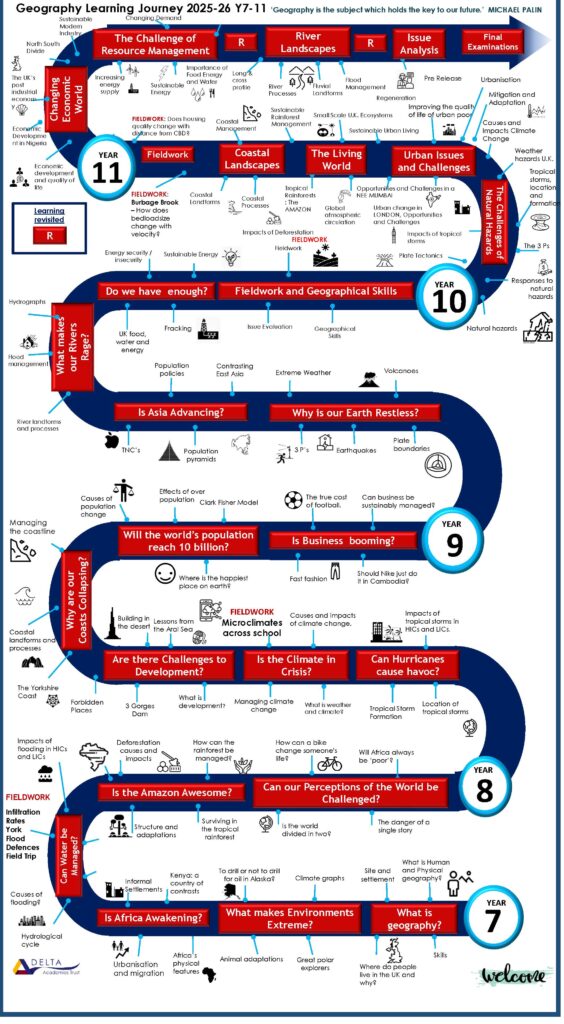
Year 7 will study a wide range of topics including map skills, ecosystems and the Amazon rainforest. They will also carry out an infiltration fieldwork investigation.
Year 8 will study a wide range of topics including natural hazards, population change and coasts. They will also carry out a microclimate fieldwork investigation.
Year 9 begin the foundation year for GCSE Geography. This covers both physical and human geography and introduces topics such as Development and Resource Management. They will also carry out an ecosystems fieldwork investigation in Gedling House Woods.
KS4
Students study a broad range of topics, covering both physical and human aspects at a range of scales, ranging from how the UK landscape is shaped to tropical rainforests, and resource management.
Year 10 topics: Natural Hazards, Urban Issues and Challenges, Coasts and Rivers. Human and physical Fieldwork. The human fieldwork compares housing quality in an inner-city area and suburban area of Nottingham whilst the physical fieldwork takes place in the Peak District. Student study how a river changes downstream.
Year 11 topics: Changing Economic World, Resource Management and Issue Evaluation.
KS5
Entry Requirements: Minimum of a grade 6 in GCSE Geography.
Assessment: Exam board: AQA.
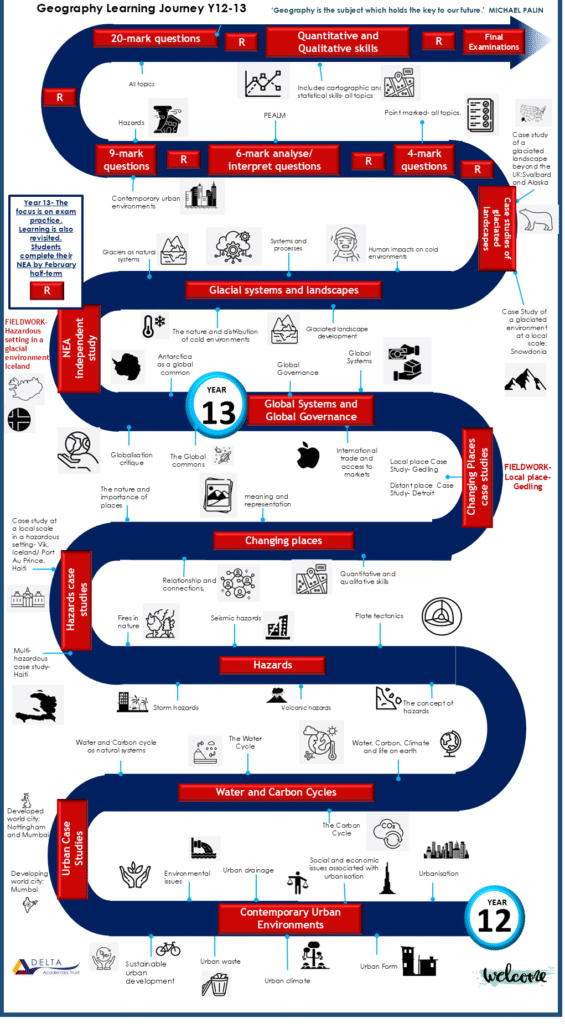
Students study a broad range of topics across Year 12 and Year 13. They are also required to complete an independent fieldwork investigation which begins in Year 12.
Paper 1 (Physical)- Hazards, Glacial Systems and Processes, Water and Carbon (2.5 hour exam worth 40% of A Level grade)
Paper 2 (Human)- Contemporary Urban Environments, Changing Places, Global Systems and Global Governance (2.5 hour exam worth 40% of A Level grade)
Coursework- Independent fieldwork investigation (approximately 5000 words- 20% of A Level grade)
| Pedagogy | Enrichment | Other general principles |
| Our pedagogy is underpinned by: * the regular use of live modelling and exemplar texts to demonstrate processes, standards and expectations. * a range of strategies to deepen knowledge so that it is committed to long-term memory * Marking and targeted feedback that informs planning and addresses misconceptions. *Trust wide assessments and timely bespoke curriculum support sessions * Using errors as a learning opportunity and building resilience. | We will enrich our curriculum by: * providing fieldwork opportunities both on and off-site. * encouraging students to contribute to the life of the school and the community, and use these ‘real’ contexts to develop their skills and knowledge in Geography * developing partnerships with external providers that extend children’s opportunities for learning. * establishing cross-curricular links. | Our curriculum will enable students to: learn within a coherent and progressive framework – progression through the course shows a reasonable match between the demand of the curriculum and the capabilities of students. * develop new skills through a variety of interesting contexts to foster enjoyment. * build on their understanding of the importance of British values, including democracy, the rule of law, individual liberty and tolerance and respect * improve their spiritual, social, moral and cultural understanding of the world. |