History
For more curricular information contact info@clwacademy.org.uk
Curriculum intent
We believe that students deserve a broad and ambitious History curriculum, rich in skills and knowledge, which immerses students in a range of cultures and engenders an enquiring and critical outlook on the world. History is a subject that forms the bedrock of our understanding of the culture in which we live as well as the wider world around us. By studying the past, it gives us the ability not only to better understand the issues and complexities of the present, but also to consider and discover solutions for the future.
Understanding key second-order concepts within History, such as significance and causation and consequence, unlock the door for students to be able to ask further questions, analyse information and convey their views in a methodical and structured way. These skills are honed and developed progressively through the curriculum to create historians confident in communicating their views, both in writing and orally. Each topic is framed around a challenging historical question, which is linked to a key historical concept. Lessons mirror this, with key questions forming the basis for each lesson enquiry. This will ensure students access and apply specialist vocabulary with increasing rigour throughout their studies.
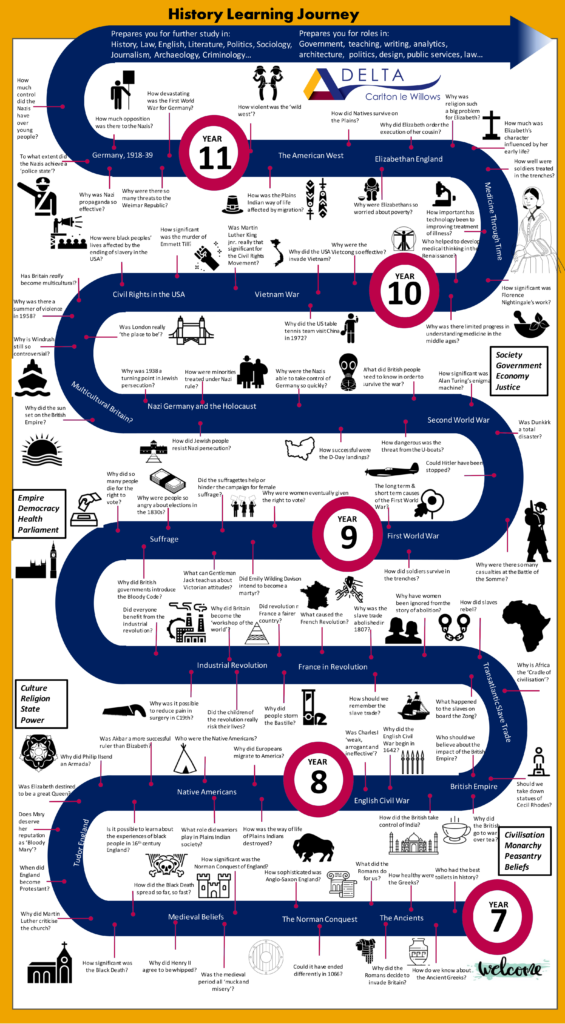
Through teaching the British, local and world history outlined in our learning journey, we have further combined overview and depth studies to help pupils understand both the long arc of development and the complexity of specific aspects of topics. As such, pupils will develop not only their knowledge and understanding of the past and the ability to analyse what happened and why, along with their understanding of how historians are able to put together a view of the past based on a variety of sources, but they will also develop the abilities that will enable them to become active members of the society and world not only that they are in, but are yet to come.
KS3
Pupils should extend and deepen their chronologically secure knowledge and understanding of British, local and world history, so that it provides a well-informed context for wider learning. Pupils should identify significant events, make connections, draw contrasts, and analyse trends within periods and over long arcs of time. They should use historical terms and concepts in increasingly sophisticated ways. They should pursue historically valid enquiries including some they have framed themselves, and create relevant, structured and evidentially supported accounts in response. They should understand how different types of historical sources are used rigorously to make historical claims and discern how and why contrasting arguments and interpretations of the past have been constructed. In planning to ensure the progression described above through teaching the British, local and world history outlined below, teachers should combine overview and depth studies to help pupils understand both the long arc of development and the complexity of specific aspects of the content.
KS4
At Key Stage 4, students follow the Edexcel GCSE History specification: Medicine through time, Early Elizabethan England, American and Weimar Germany.
The content is assessed through a question on features of the period and also through a historical enquiry. For the historical enquiry, students will need to develop the skills necessary to analyse, evaluate and use contemporary sources to make substantiated judgements, in the context of the historical events studied. To aid teaching, the content is divided into two sections: the first covers the site in its historical context; the second covers knowledge, selection and use of sources relevant to this historic environment for enquiries
The aims and objectives of this qualification are to enable students to:
● develop and extend their knowledge and understanding of specified key events, periods and societies in local, British, and wider world history; and of the wide diversity of human experience
● engage in historical enquiry to develop as independent learners and as critical and reflective thinkers
● develop the ability to ask relevant questions about the past, to investigate issues critically and to make valid historical claims by using a range of sources in their historical context
● develop an awareness of why people, events and developments have been accorded historical significance and how and why different interpretations have been constructed about them
● organise and communicate their historical knowledge and understanding in different ways and reach substantiated conclusions.
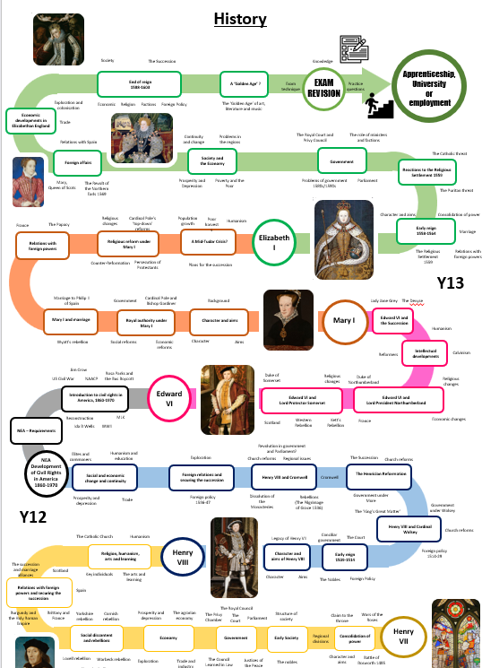
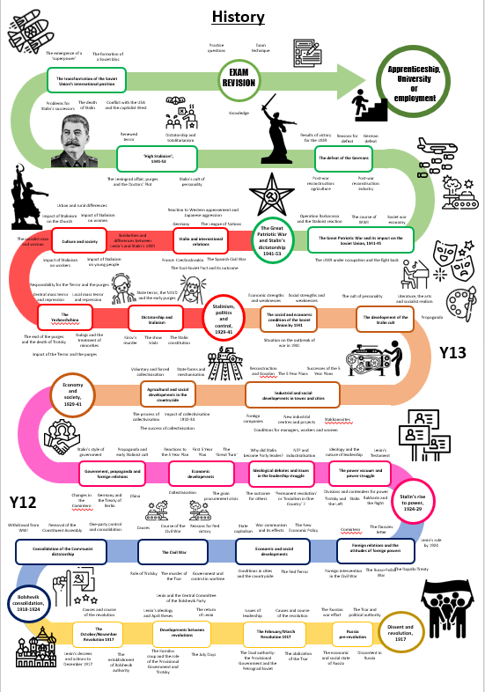
KS5
A-Level History curriculum intends to transform students into independent, critical, and rigorous historians. We aim to move beyond the acquisition of facts, challenging students to navigate the complexity of human experience and the provisional nature of historical truth. By exploring a diverse range of periods, cultures, and political systems, we provide students with the cultural capital and analytical tools necessary to decode the power structures of the modern world. Our curriculum intends to provide a study of ‘Power and Authority.’ By contrasting the personal monarchy of the Tudor Dynasty with the ideological totalitarianism of the Soviet Union, students will evaluate how leaders across different centuries have sought to manufacture consent, manage dissent, and project power. This dual-focus ensures students understand both the roots of the British state and the geopolitical forces that define the modern world
| Pedagogy | Enrichment | Other general principles |
| The Delta History curriculum is structured chronologically, providing students with a coherent narrative of the past. It begins with a foundation in British history, before extending to global, continental, and regional contexts. The curriculum is centred on compelling historical narratives, focusing on significant people, events, and turning points. Students are encouraged to view history as a complex and contested discipline, shaped by diverse perspectives. Through the study of both historical figures and the historians who interpret their actions, students develop critical disciplinary thinking. This approach equips them to make well-reasoned, evidence-based judgements about the past. The History curriculum immerses students in a range of cultures and engenders an enquiring and critical outlook on the world, with skills that can be applied throughout their lives and in their future academic endeavours. Each topic is framed around a challenging historical question, which are linked to a key historical concept Key enquiry questions forming the basis for each lesson. Understanding key concepts within History, such as significance and causation and consequence, unlock the door for students to be able to ask leading questions, analyse information and convey their views in a methodical and structured way. By analysing cause and consequence, change and continuity, and historical significance, students learn to organize the chaos of the past into logical, evidence-based arguments rather than just a chronological list of events. Our curriculum reflects a wide range of human experiences, incorporating “hidden histories” of women, the working class, and ethnic minorities, fostering a more inclusive and accurate understanding of the past. All of this is anchored by a firm chronological framework, which provides students with the mental map necessary to understand how different eras connect. This holistic approach transforms the classroom from a place of passive listening into a laboratory of active investigation. | * Remembrance Day/Holocaust and KS3/KS4 assemblies * KS3 History Club -weekly history club that explores aspect of history not delivered through the curriculum * KS5 weekly reading assignment. For both History and Politics students. Developing historical enquiry and topical politics discussion. | The History curriculum effectively challenges and scaffolds students, they build on skills from one year to the next, while also studying different content. The later years in the curriculum prepare students for post 16 pathways by allowing key structures to be embedded throughout. We follow a five-year curriculum map which builds on prior knowledge and prepares students for their next stage of study. All lessons are differentiated to ensure they are accessible to all. Staff are aware of any students with SEND (Passports) to ensure their needs are met. Staff understand how the reading ages of their students should inform how lessons are differentiated and how reading strategies are selected. History is a subject that forms the bedrock of our understanding of the culture in which we live as well as the wider world around us. History forces you to step into the shoes of people whose lives were radically different from your own. It helps you understand the human condition. As we navigate rapid changes in technology and climate, history reminds us that humanity has been through massive shifts before. Whether it was the Industrial Revolution or the end of Empires, history shows us how societies adapt, survive, and occasionally thrive during chaos. Ultimately, history provides the “user manual” for humanity, showing us how societies have adapted to massive shifts in the past so that we are better prepared to face the challenges of the future. |