PE
For more curricular information contact info@clwacademy.org.uk
Curriculum intent
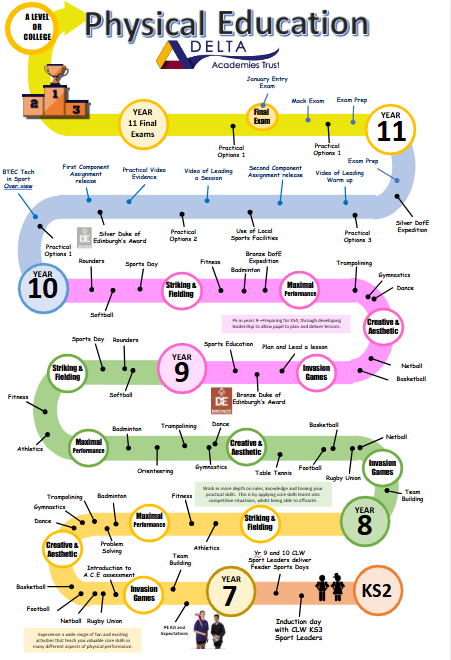
Pupils follow content according to the National Curriculum for Physical Education. Which allows pupils to experience a balanced and varied curriculum allowing pupils to participate in a wide variety of activities as well as participating in competitive team and individual activities as well as dance and gymnastics (through Trampolining). Pupils are also taught to use technical terminology with confidence accurately and precisely, building up an extended specialist vocabulary; can apply their mathematical knowledge to their understanding of PE, including measuring, timing, estimating and analysing data. Attend extra-curricular sporting clubs and competitions, have an opportunity to represent their school and community. Develop a lifelong love of sports and physical exercise. Make positive informed choices around their health, well-being and diet. Link the benefits of a healthy diet and physical activity to mental and physical well-being. Develop their leadership qualities and skills through sport. Have a sound understanding of different sports, their origins, including British and worldwide sporting role models. Are prepared to transition from Key Stage 3 to Key Stage 4 with the skills, knowledge, character and leadership to excel in Key Stage 4. Promoting underlying themes/components of BTEC Tech in Sport qualification.
The intention of the Physical Education curriculum is for pupils to build and develop upon the fundamental skills taught across Key Stage 2. At Carlton le Willows Academy we aim for pupils to develop values and transferable skills, such as fairness and respect, as well as techniques, tactics, knowledge and understanding across a wide range of activities. In lessons, students will have opportunities to develop leadership skills such as; communication, fairness, planning and organisation, improving confidence, the ability to solve problems and evaluate themselves and others. Pupils are encouraged to develop knowledge and appreciation of rules and regulations, as well as the awareness of safety considerations when exercising.
There is a comprehensive range of extra-curricular activities throughout the year, open to all students. These give students the opportunity to develop their skills and techniques further and, if the students want to, they can represent the Academy against other schools and compete at district, county and national level. As well as opportunities to develop as a performer, students have the chance to develop their leadership skills by completing Sports Education and all levels of the Duke of Edinburgh Award.
KS3
Year 7: Students will develop their KNOWLEDGE of:
- basic skills, techniques and tactics used in sports and physical activities
- fundamental rules and regulations for a range of sports and the need for officials
- the components of a warm-up and cool down
- the immediate effects of exercise of body and basic training methods to improve cardiovascular fitness
- some compositional ideas to improve Dance
- safety factors during physical activity and sport
- leading fit and healthy lifestyles including extracurricular sports clubs
Students will develop their SKILLS in:
- racquets/striking and fielding/invasion games/athletics/dance/outdoor and adventurous activities/health related exercise
- teamwork
- fundamental techniques in a range of sports in isolation and simple drills
- overcoming opponents in competitive situations in team and individual games (e.g. rugby/netball/badminton/tennis).
- decision making in competitive sports
- basic dance styles and techniques, including replication and some creativity
- simple reasoning and questioning in attempting to solve problems
- identifying strengths and weaknesses of their own and others’ work
- leadership of warm ups and cool downs
- officiating conditioned practices or Small sided games in some sports
Year 8: Students will develop their KNOWLEDGE of:
- More advanced skills, techniques and tactics used in sports and physical activities
- Rules and regulations for a range of sports and the roles of different types of officials
- The components of an activity session (warm up, main activity, conditioned practice, cool down)
- The immediate and some long-term effects of exercise on the body and training methods to improve at least two components of fitness
- More advanced compositional ideas to improve performance in Dance
- Safety factors during physical activity and sport for more advanced activities (e.g. scrummaging in rugby)
- The benefits of leading fit and healthy lifestyles including extracurricular sports clubs
Students will develop their SKILLS in:
- Racquets/striking and fielding/invasion games/athletics/dance/outdoor and adventurous activities/health related exercise
- Teamwork
- Techniques in a range of sports in increasingly complex drills under pressure
- Overcoming challenging opponents in competitive situations in team and individual games (e.g. rugby/netball/badminton/tennis).
- Pressured decision making in competitive sports, including some analysis of opponents’ strategies
- Contemporary and traditional dance styles and techniques, including accurate replication and developing choreography
- Reasoning, questioning and listening to the contributions of others in order to solve problems
- Identifying strengths and weaknesses of their own and others’ work and suggesting improvements
- Leadership of warm ups, basic drills and cool downs
- Officiating with competence in a greater range of sports and roles
Year 9: Students will develop their KNOWLEDGE of:
- advanced strategies, tactics and skills used in sports and physical activities.
- rules and regulations for a range of sports and the roles of different types of officials
- short and long-term effects of exercise on the body to muscular, cardiovascular and respiratory systems
- choreographed dances with advanced ideas
- safety factors during physical activity and for more advanced activities
- the components of fitness and how you can improve them by using methods of training and principles of training
- the benefits of leading a healthy active lifestyle – through exercise and diet, to also include physical activity outside of school.
Students will develop their SKILLS in:
- racquets/striking and fielding/invasion games/athletics/dance/health related exercise
- team work
- using advanced techniques, strategies and tactics in a range of sports in competitive game situations
- being able to make the correct decisions in competitive situations to allow you to beat an opponent regularly
- contemporary and traditional dance styles and techniques, developing choreography and using the four dance key themes effectively in your work
- analysing performance of yourself and others during performance to alter the outcome of a game
- leading groups of students on part of a session, feeding back so others can make improvements
- officiating a variety of roles within a sport – line judge and match referee in badminton and over more than one sport
KS4
Year 10 and 11
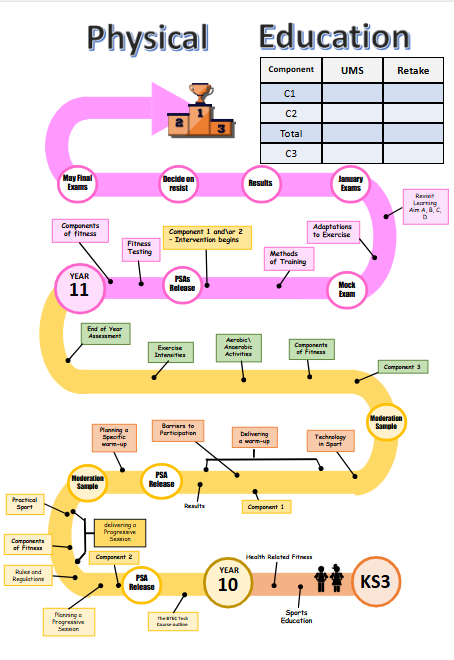
As part of the Key Stage 4 Core PE curriculum we look to implement all that has been practically learnt in KS3 and apply this into a personalised pathway for pupils.
We continue to tackle complex and demanding physical activities. Pupils get involved in a range of activities that develops personal fitness and promotes an active, healthy lifestyle.
Pupils should be taught to:
- Use and develop a variety of tactics and strategies to overcome opponents in team and individual games for example, badminton, basketball, cricket, football, netball, rounders, table tennis and rugby
- Develop their technique and improve their performance in other competitive sports, for example, athletics and Trampolining.
- Pupils are offered further outdoor and adventurous activities in in the form of Silver Duke of Edinburgh’s Award which includes a range of environments which present intellectual and physical challenges and which encourage pupils to work in a team, building on trust and developing skills to solve problems, either individually or as a group.
- Evaluate their performances compared to previous ones and demonstrate improvement across a range of physical activities to achieve their personal best
- We look to enrich the curriculum by offering activities at local sports venues to promote pupils to continue independently taking part regularly in competitive sports and activities outside school through community links or sports clubs.
KS5
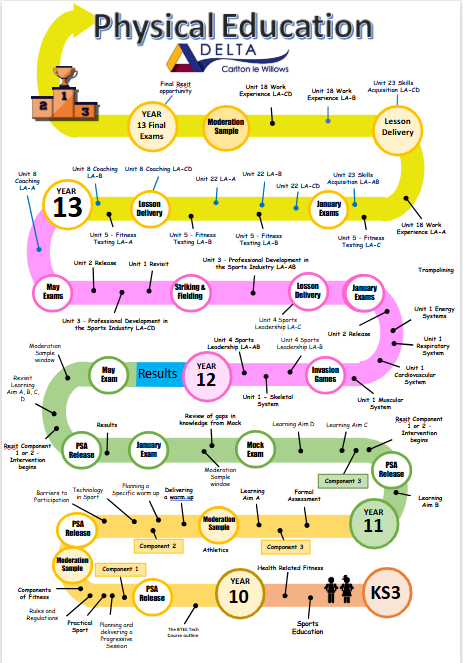
The Pearson BTEC Level 3 National Diploma in Sport is intended to be an Applied General qualification for post-16 Pupils wanting to continue their education through applied learning, and who aim to progress to higher education and ultimately to employment, possibly in the sports sector. The qualification is equivalent in size to two A Levels and has been designed as a two-year programme when studied alongside further Level 3 qualifications.
The content of this qualification has been developed in consultation with academics to ensure that it supports progression to higher education. Employers and professional bodies have also been involved and consulted to confirm that the content is appropriate and consistent with current practice for Pupils who may choose to enter employment directly in the sport sector. The mandatory content allows students to concentrate on the development of their practical skills and the broad knowledge required for entrance into higher education programmes in sport. Pupils will study six mandatory units:
- Unit 1: Anatomy and Physiology
- Unit 2: Fitness Training and Programming for Health, Sport and Well-being
- Unit 3: Professional Development in the Sports Industry
- Unit 4: Sports Leadership
- Unit 22: Investigating Business in the Sport and Active Leisure Industry
- Unit 23: Skill Acquisition in Sport.
Pupils also choose three units from a range of optional units that have been designed to support progression to a variety of sport courses in higher education and to link with relevant occupational areas. This allows Pupils either to choose a specific specialist area in which they wish to develop their skill, or continue on a broad programme.
| Pedagogy | Enrichment | Other general principles |
| Our pedagogy is underpinned by: * a spiral curriculum basing future teaching on the building blocks taught previously; * delivery as practical lessons, aiding Kinaesthetic, Visual and Auditory learning styles; * variation to develop deep and holistic understanding; * concepts that are broken down into small connected and structured steps enabling application to range of contexts; * emphasis placed on performing, especially skills in isolation, which will build to competitive situations; * pupils will also learn leadership skills as an official and coach so that the performance knowledge can be further embedded; * procedural fluency and repetition of skills to aid; * interventions that are timely, planned and effective from Trust wide unified assessments; | After School Enrichment opportunities are: *Athletics * Basketball * Badminton *Cross Country * Football * Netball * Rugby * Table Tennis Residential Opportunities * Football Residential * Netball Residential Duke of Edinburgh’s Award * Bronze DofE * Silver DofE * Gold DofE Beyond DofE * Lowland Leaders Award * Outdoor Two Day First Aid | * Ready to learn and quick to settle *Takes responsibility for learning * Has a thirst for learning * Willing to work independently with focus/without teacher input *Willing to actively participate in a variety of situations * Seeks to develop learning by questioning * Takes risks to further learning * Maintains a positive relationship with others * Shows respect at all times * Always puts effort into learning *Takes responsibility for their own and others safety in school/classroom/learning environment |