Science
For more curricular information contact info@clwacademy.org.uk
Curriculum intent
“All life is problem solving.”
– Karl Popper
The science curriculum at Carlton le Willows Academy has been designed to provide students with a deep understanding of the scientific knowledge and ideas that impact them as individuals within a local and globalised context. As they move through the curriculum, students will be increasingly encouraged to develop their curiosity, provide insight into working scientifically and appreciate the value of science in their everyday lives. Our curriculum provides a platform for more advanced science-based study, providing a gateway into a wide range of career opportunities. It also delivers a framework for understanding the natural world and supporting students to become scientifically literate participants in society.
The key principles used when designing the curriculum were:
- To develop a knowledge-rich curriculum, supported by high quality teacher instruction, and the opportunity for students to demonstrate understanding.
- Effective use of models to explain concepts and critical evaluation of these models.
- Development, understanding and use of scientific language and commonalities in language between other curriculum areas.
- The sequence of learning, including prior knowledge and next steps.
- Retrieval of information over time.
- Reduction of topic/end of term tests, and more frequent ‘low stakes’ checkpoints that feed back into classroom planning.
- Links to other subjects as well as national and global and social context.
KS3
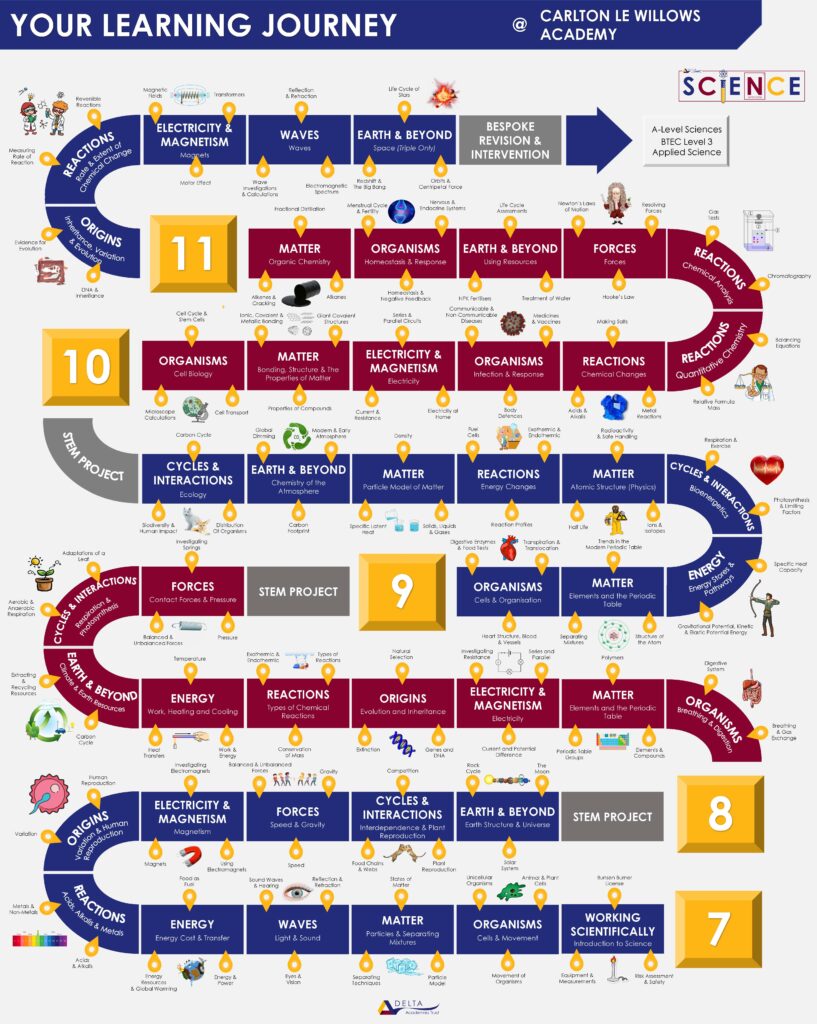
Students follow content according to the National Curriculum for science using a clear strand-based approach, which reviews and builds on understanding from Key Stage 2. Practical skills are modelled for students with opportunities for them to develop the skills of enquiry and working scientifically.
During Key Stage 3 students will also have the opportunity to experience areas of science beyond the National Curriculum. These are planned to include subjects such as astronomy, psychology, marine biology, and geology. Using the expertise of the wider trust, we are able to offer our students the opportunity to experience short programs of study in these areas, with links to possible careers.
KS4
Students experience a wide range of new topics and skills at Key Stage 4 whilst following the AQA Trilogy or Triple science specifications. Each topic strand is linked intrinsically to prior knowledge and skills from Key Stage 3 and builds in terms of complexity, skills and application. Our aim is that all students should leave the academy being able to understand and explain the scientific world around them and more importantly are equipped with the skills to problem solve and critically evaluate the ‘big’ moral questions.
To support this, the design of Learning Journeys have been carefully planned and aligned to the curriculum narrative. Learning journeys are carefully embedded into the curriculum structure to ensure that this meets the need for improving literacy and provides opportunities for retrieval practice. This also ensures that new key language is introduced, explained, and modelled when building on prior learning within each strand. Assessment for learning of students’ understanding of the curriculum is frequent and low stakes. This is done through drills, mini-whiteboard tasks, planner colour exercises, and connect and demonstrate tasks. The aim of this assessment for learning is to feed directly into planning so that lessons use adaptive teaching that is personalised to meet the needs of all students.
KS5
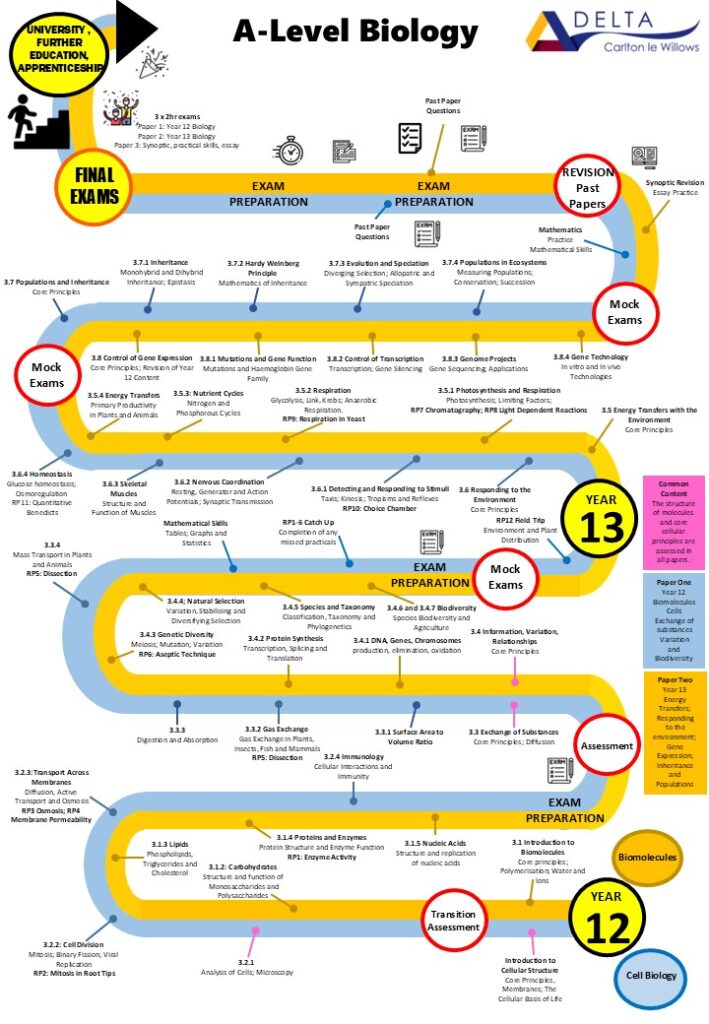
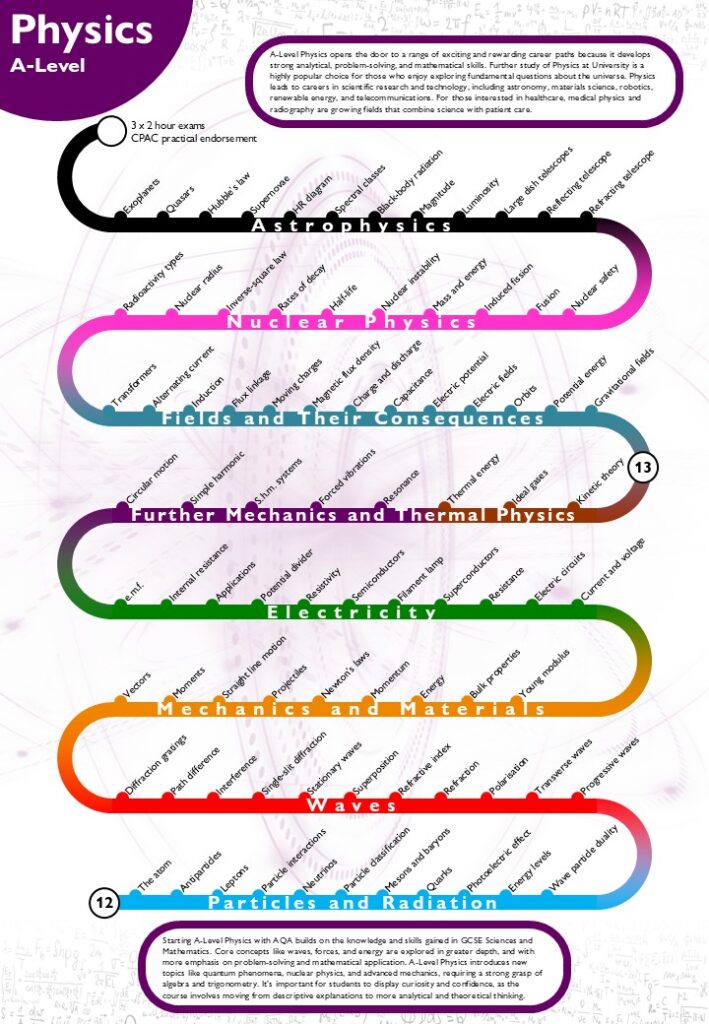
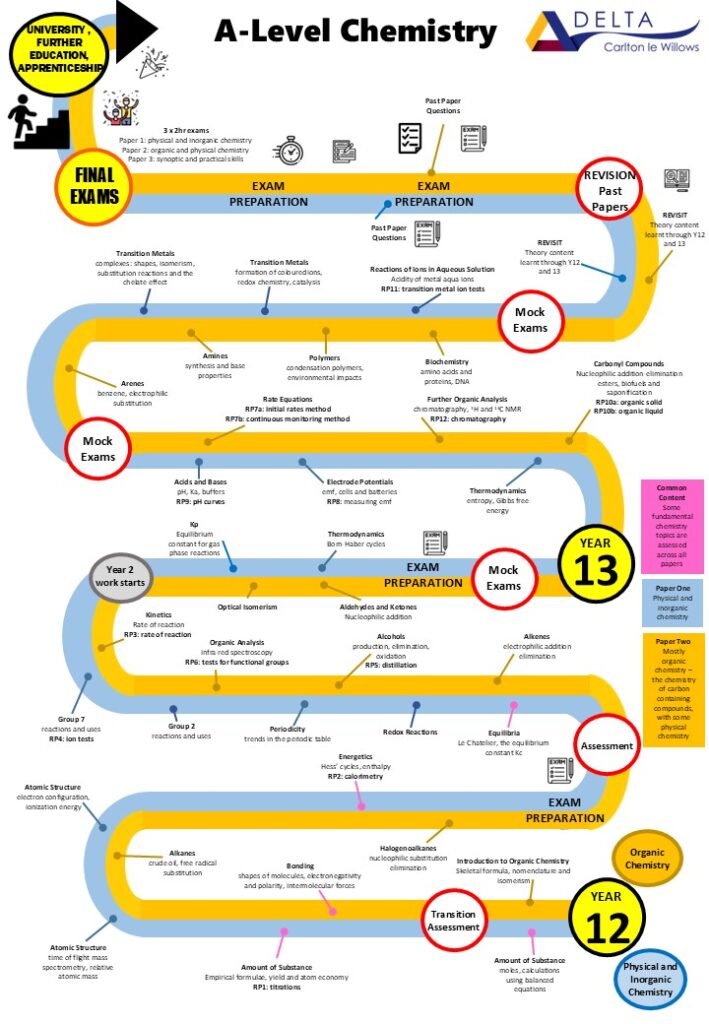
Post 16 Science builds upon core concepts that have been cemented at Key Stage 4 but now push students into finding their own direction through A Levels in Biology, Chemistry, and Physics. Our programme of study for years 12 and 13 is a knowledge-based curriculum, empowering students to develop an understanding and appreciation of the subjects they study and push them into becoming fully independent learners. Our curriculum is carefully designed and delivered by subject specialists to ensure learning independently is at the heart of what we do and therefore prepare our students for the next steps in the lives.
To facilitate this, all A level courses are built on the following key features:
- To develop a knowledge-rich, structured post 16 curriculum delivered by high quality teaching.
- Low stakes testing and quality feedback ensuring retention of, and understanding of, key principles that underpin application.
- Promotion of self-discipline and self-regulation of study time to develop our post 16 cohort into independent learners who can work through and solve problems with only small amounts of intervention.
The intent is centred around nurturing and moulding our Key Stage 5 students into resilient, resourceful, and independent young adults who have the skills to succeed in whatever path they choose to take when they leave Carlton le Willows Academy.
| Pedagogy | Enrichment | Other general principles |
| Our pedagogy is supported by: Strand-based approach to teaching, allowing students to revisit content and deepen their knowledge; Clear modelling of scientific concepts and high quality teacher instruction; Demonstrate and connect marking which informs planning and addresses misconceptions; Trust wide assessments and timely intervention; Using errors as a learning opportunity and building resilience. | We will enrich our curriculum by: Extended tasks beyond the curriculum, including STEM projects at the end of Y7-Y9; Encouraging students to become eco-students using the curriculum as a mechanism to enhance awareness of local and global issues; Continue to develop inter-academy STEM links; Continue to build on existing cross-curricular links; Complete bespoke short POS in areas of interest. | Our curriculum will enable students to: Learn within a coherent and progressive, strand-based approach allowing students to revisit and move at a more personalised rate; Develop new skills through a variety of interesting contexts to ensure engagement; Develop a wide range of practical skills, deepen skills of enquiry; Improve their social and moral understanding of the world and be able to form reasoned opinions around ‘big’ scientific questions. |